Personification is the attribution of human characteristics to things that are non-human. Writers use personification to give human characteristics such as emotions and behaviors to non-human things animals and ideas.
Personification Ecole Westridge Library Learning Commons
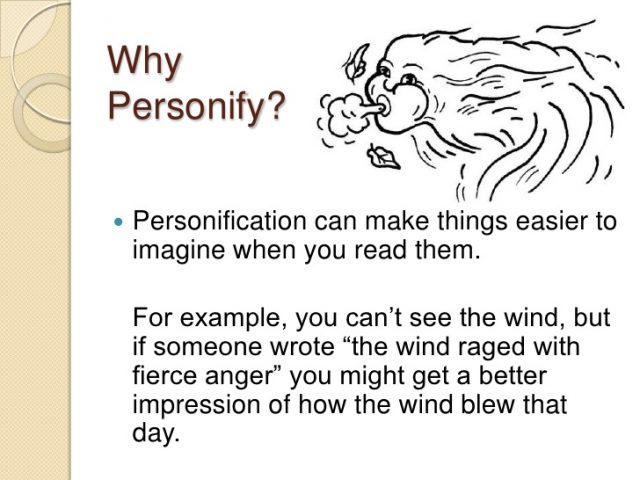
Personification per-SAHN-nuh-fuh-KAY-shun is a technique of figurative language that endows non-human subjects with human characteristics.

What is the use of personification. The use of personification in poetry helps the reader develop a connection between a distant object and feel sympathy for that object. The human trait assigned to. Personification is a literary technique that gives human characteristics to inanimate objects or non-living things that would otherwise not experience emotions or other human responses to events.
Here it helps the author build a more believable story as the reader will be drawn in by the emotions the object is feeling It helps feed the imagination so the reader is more engrossed in the story. In this sonnet we see the personification of natural forces. Personification can be used when writing fiction.
Personification is also heavily featured in poetry and songs. The statement the story jumped off the page is a good example of personification. Personified animals ideas and inanimate objects may exhibit human emotions or perform human actions.
Personification may be used to evoke emotions in a reader. Personification is a literary device that uses the non-literal use of language to convey concepts in a relatable way. Personification is a literary tool that paints a vivid picture of landscapes celestial objects and other natural wonders for readers.
The use of personification in the literature has great impact as it showcases a non-human entity more vivid and lively along with a human attribute. Personification is giving human attributes to something that is. This is an example of personification that is used to illustrate the nonstop action of one of the most exciting cities in the world.
The use of the adjective darling to. The fables of Aesop dating to at least 400 BC were famous for giving human motives and failings to animals and natural forces such as the wind and the sun. Personification makes written descriptions vivid and more unique helping readers to better relate to your writing.
In essays and advertisements poems and stories personification is used to convey attitudes promote products and illustrate ideas. The use of personification in literature includes some of the earliest surviving literary works. The best fiction writers know how to wield this powerful tool making their work come alive in our imaginations more than a literal description ever can.
Did you identify the personification in the examples above. Can you identify what is being personified in each sentence and what human trait. Examples 1 Through 25 Answers.
Personification in poetry is the process of giving human traits or characteristics to a non-human object or idea. What Is the Use of Personification. 50 Ways to Use Personification Personification Examples 1 Through 25.
This figure of speech is a form of metaphor in that it ascribes the qualities of one thing to another. Anthropomorphism is a term that originally meant giving human characteristics. The word personification has the word person.
Personification refers to giving human traits to things like animals. Personification is a special kind of figurative language that writers use when they give inanimate objects and concepts the traits of a human being. The term personification came into usage around 1700 and is often used as an umbrella term to denote the attribution of human characteristics to something non-human.
It is a figure of speech which is a way for authors to add color and life to subjects and characters by emphasizing and clarifying characters and scenes and adding dimension and color to characters and scenes.

Personification A Human Touch Ppt Video Online Download
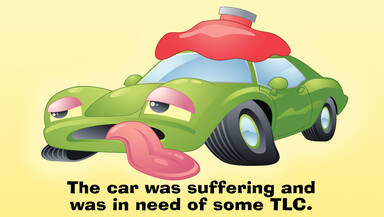
Examples Of Personification